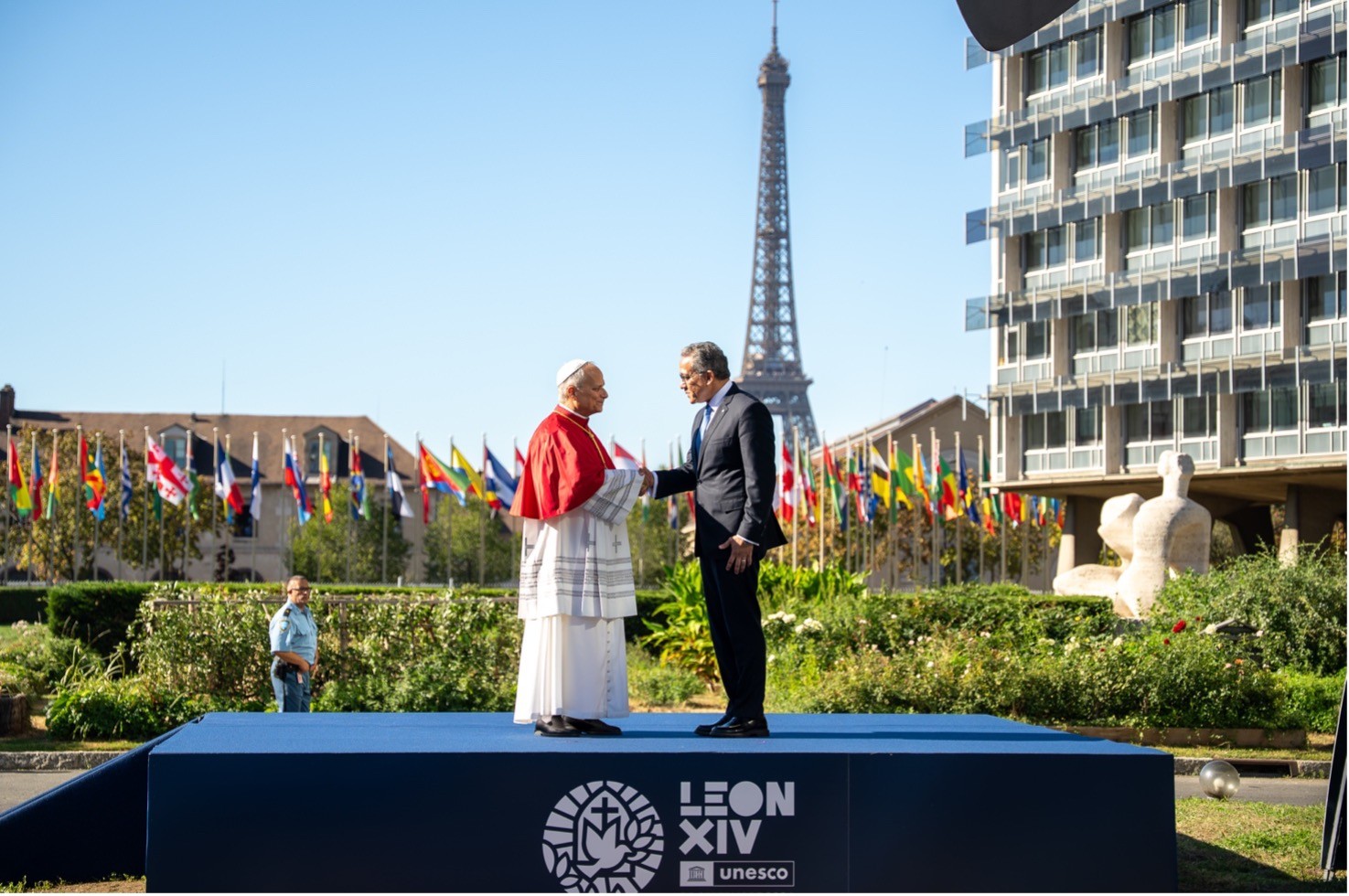
On 25 September 2026, Pope Leo XIV paid an official visit to UNESCO Headquarters in Paris, the first visit by a Pontiff to the Organization since that of Pope John Paul II in 1980. The visit provided an opportunity to reaffirm the longstanding cooperation between the Holy See and UNESCO and to reflect on some of the major challenges facing humanity, particularly the impact of digital transformation and artificial intelligence on human dignity, education and young people.
Welcoming the Holy Father, UNESCO Director-General Khaled El-Enany recalled the longstanding ties between the Organization and the Holy See, which has held Permanent Observer status at UNESCO since 1952. He also highlighted the significance of Pope Leo XIV’s decision to visit UNESCO as the first international organization outside Rome to receive an official visit from him during his pontificate.
A symbolic moment of the visit took place in UNESCO’s Square of Tolerance, where Pope Leo XIV and the Director-General jointly watered the Olive Tree of Peace. The opening words of UNESCO’s Constitution were also recalled: since wars begin in the minds of men, it is in the minds of men that the defences of peace must be constructed. The gesture underscored the shared commitment of the Holy See and UNESCO to promoting a culture of peace through education, dialogue and international cooperation.
In his address, Pope Leo XIV described UNESCO as a place where humanity can reflect on itself, its history and its future. He stressed that international agreements and treaties, while indispensable, cannot by themselves guarantee peace: they must be accompanied by a culture of peace and a shared commitment capable of sustaining them.
A central part of the Pope’s address concerned the profound transformations brought about by the digital age and artificial intelligence. Addressing an audience of around 1,400 people, Pope Leo XIV drew attention to the distinction between the growing availability of information and genuine human knowledge and wisdom. While communication has become faster and information more abundant, this does not necessarily make communication more truthful or knowledge more meaningful. Artificial intelligence, he observed, can process and correlate enormous quantities of data, but it cannot answer the fundamental questions concerning the meaning of human existence, which remains rooted in lived human experience.
The Holy Father therefore emphasized the importance of safeguarding those qualities that are proper to human intelligence, including critical thinking and the search for truth. In this context, he expressed appreciation for UNESCO’s work in the field of Media and Information Literacy, stressing the close relationship between the challenges of communication and those of education.
Particular attention was devoted to children and young people. Pope Leo XIV called on the international community to ensure that their vulnerability in the digital environment never becomes an opportunity for exploitation. New technologies, he stressed, should contribute to their growth, education and relationships, while safeguarding their freedom to think and discern and remaining at the service of the dignity of the human person.
These concerns were also at the heart of UNESCO’s Forum on Youth in the Age of AI, held on the same day. Scholars, philosophers, scientists, artists and content creators discussed the consequences of artificial intelligence for culture, education and access to information, with particular attention to the empowerment of young people and to the conditions necessary for technology to enhance, rather than diminish, their freedom, judgement and creativity.
The visit also highlighted the convergence between the Holy See and UNESCO on the need for technological development to remain centred on the human person. Director-General El-Enany underlined UNESCO’s efforts to promote artificial intelligence that serves people and identified the Organization as an important platform for helping young people understand and master these technologies and use them as tools that can provide opportunities and foster their full participation.
Concluding his visit, Pope Leo XIV thanked UNESCO and its staff for their commitment to advancing peace through education, science and culture. He expressed the hope that the encounter would strengthen awareness of belonging to one human family and addressed a particular message to young people and their aspirations for justice.
The visit thus reaffirmed the longstanding relationship between the Holy See and UNESCO and their shared commitment to international cooperation, peace and the protection of human dignity, at a time when the rapid pace of technological change is raising new questions about knowledge, education and the very meaning of being human.