
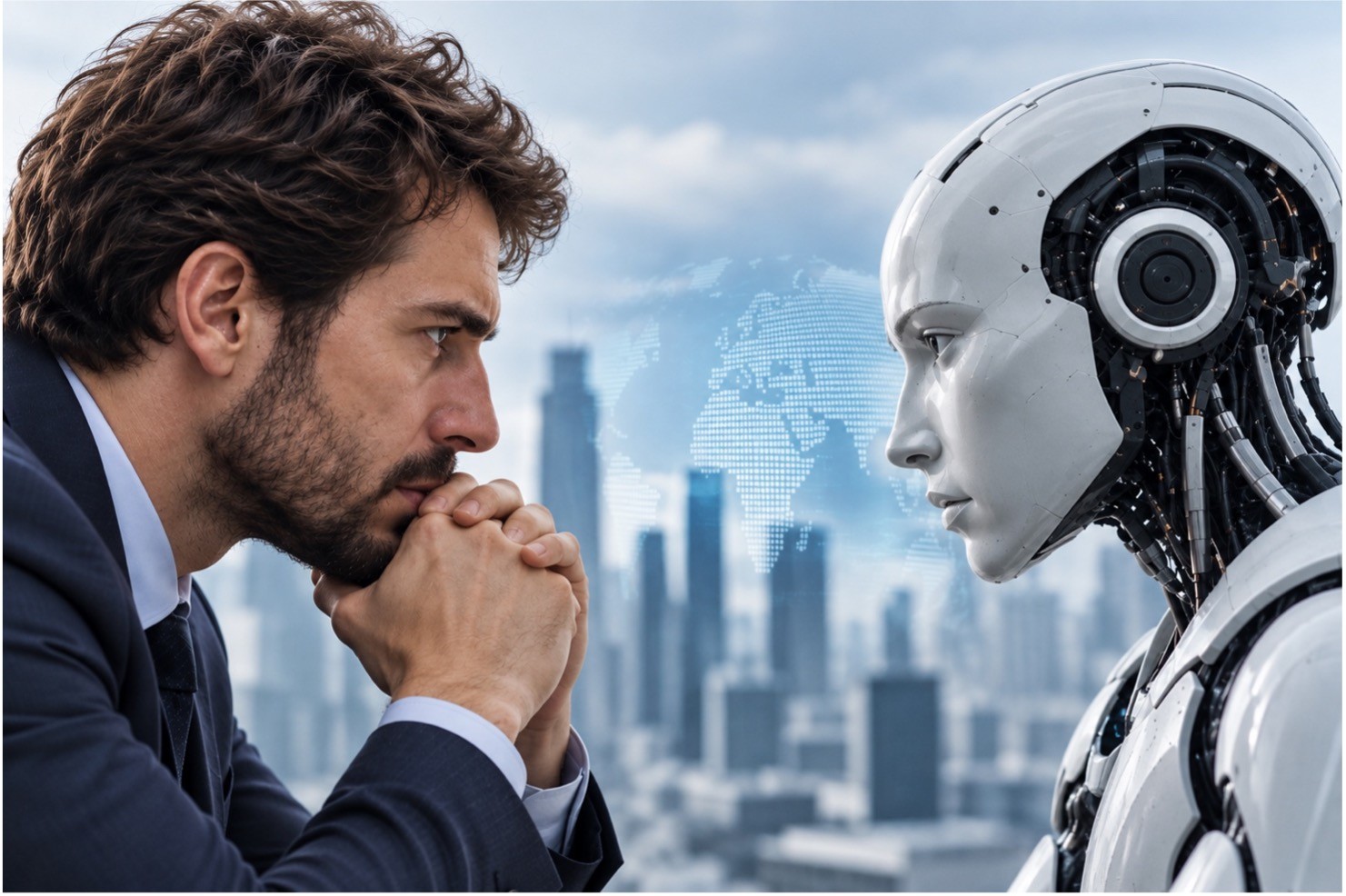
The rapid advance of artificial intelligence is opening up extraordinary possibilities, but it is also raising increasingly urgent questions. Geoffrey Hinton, winner of the 2024 Nobel Prize in Physics and one of the pioneers of deep learning, draws attention to the risks posed by systems capable of learning and operating with growing levels of autonomy. Among the threats under consideration are the use of AI in cyberattacks, the development of biological weapons and, in the longer term, the difficulty of controlling systems far more powerful than those currently available.
Yet the issue is not limited to extreme scenarios. Luciano Floridi, philosopher and Director of Yale University’s Digital Ethics Center, identifies risks that are already present: the concentration of technological power in the hands of a small number of companies and States, the manipulation of information, and people’s gradual relinquishment of their own independent judgement. The fundamental issue therefore becomes one of responsibility: a task may be delegated to artificial intelligence, but responsibility for its consequences cannot.
Particular attention must be paid to decisions that are difficult to reverse and to those affecting people’s lives, the environment, healthcare, employment, education and justice. In these areas, there must always be a clearly identifiable person who bears responsibility and is able to explain and justify a decision.
The Church’s reflection also forms part of this debate. Pope Leo XIV has stressed the need not to entrust algorithms with decisions that belong exclusively to human beings. Father Alberto Carrara, philosopher and professor at the Pontifical Athenaeum Regina Apostolorum, further emphasises that the challenge posed by AI is not merely technological but profoundly anthropological: before asking what technologies we are capable of building, we must ask what vision of the human person and of society they are intended to serve.
The real question, therefore, is not simply how intelligent a machine may become, but how much authority human beings are prepared to entrust to it.