
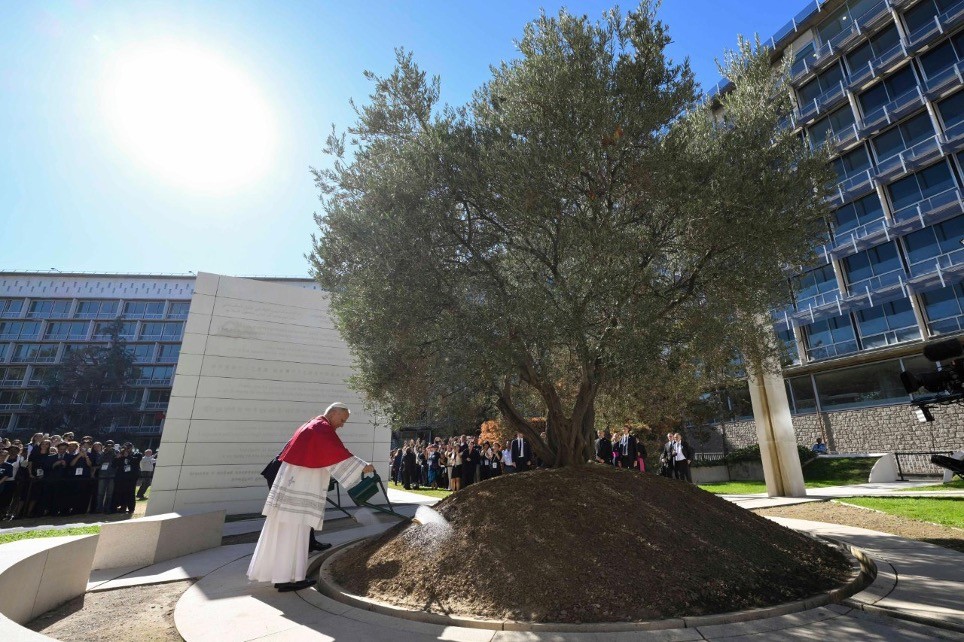
During his visit to UNESCO headquarters in Paris, the second stop on his Apostolic Journey to France, Pope Leo XIV presented himself as a “witness to peace”, calling on the international community to assume its responsibility to build a more just world, in which education, science and culture are placed at the service of the human person and the common good.
At the heart of the Pope’s address was an appeal to uphold the dignity of every human being. Life, he stressed, must be recognized as a gift and not reduced to a commodity or assessed solely according to criteria of efficiency and productivity. Human dignity is not diminished by illness, suffering or frailty, but requires care and protection at every stage of life. Particular attention must be given to the most vulnerable: children, persons with disabilities, the elderly, migrants and refugees.
Leo XIV then issued a strong appeal against war, describing it as the most terrible of human works, particularly when science and technological progress are placed at the service of destruction. Recalling UNESCO’s founding principle that the defences of peace must be built in the minds of men and women, the Pope reiterated that “peace cannot be built by treaties alone”. Rather, it is born of justice, a will directed towards the good, and the ability to recognize in others a brother or a sister.
Considerable attention was also devoted to new technologies and artificial intelligence. The Pope called for vigilance to ensure that technological progress remains at the service of the human person and does not become an instrument of domination and injustice. In a world characterized by increasingly rapid communication that is not necessarily more truthful, he also emphasized the essential role of education and formation in discernment, particularly in protecting children and young people from the risks of the digital environment.
The Pope also highlighted the importance of dialogue and international cooperation at a time when institutions are facing a crisis of trust and effectiveness. Differences, he observed, should not necessarily be regarded as a threat: sincere dialogue among peoples and cultures can instead contribute to the pursuit of the common good.
From this perspective, Leo XIV encouraged UNESCO to continue its efforts to foster understanding among nations, making education a means of overcoming mutual fears and science a resource at the service of life. Only through a common commitment founded on human dignity, truth and fraternity, the Pope concluded, can “peace finally flourish”.