
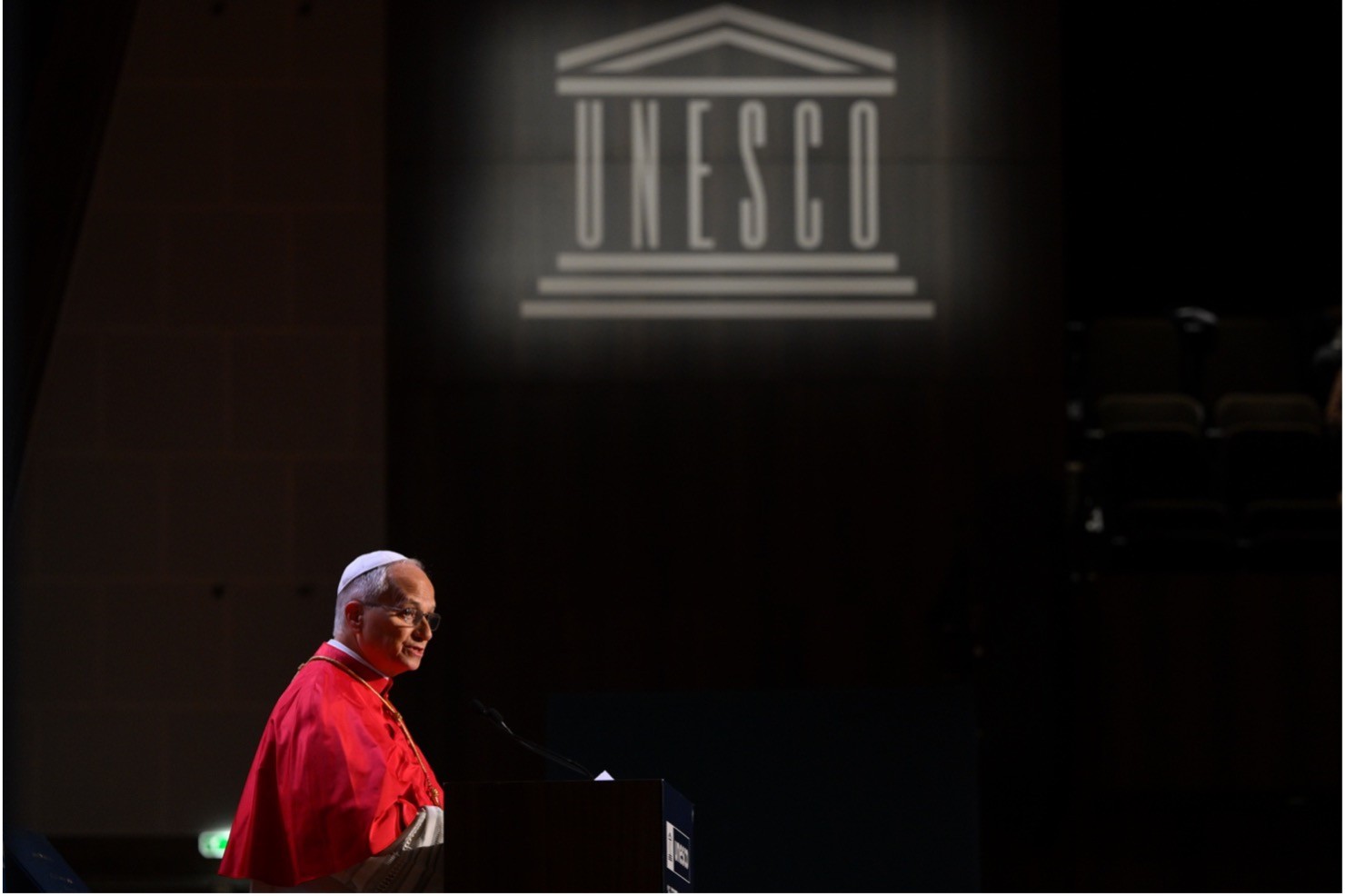
During his visit to UNESCO headquarters in Paris, as part of his Apostolic Journey to France, Pope Leo XIV appealed to the international community to ensure that education, culture, science and technology remain firmly at the service of human dignity, truth and peace.
Forty-six years after the historic visit of Saint John Paul II to UNESCO, the Pope recalled the Holy See’s longstanding engagement with the Organization, where it has been represented as a Permanent Observer since 1952, describing UNESCO as a privileged partner in promoting the common good and the integral development of the human person.
At the heart of his address, Leo XIV posed a fundamental question: “What does it mean to be human?” According to the Pope, this question must also guide education, which cannot be limited to the transmission of skills, but must help new generations reflect on the meaning of life and on their responsibility towards others.
Particular attention was given to the transformations brought about by technology and artificial intelligence. While acknowledging their great potential, the Pope stressed the need to accompany scientific progress with sound ethical principles, ensuring that the human person is not assessed solely according to criteria of efficiency and productivity. He also emphasized the need to protect children and young people from the risks of the digital environment and to use new technologies in support of education, human relationships and the capacity for discernment.
Recalling UNESCO’s founding principle that the defences of peace must first be built in the minds of men and women, Leo XIV reiterated that “peace cannot be built by treaties alone.” It requires justice, dialogue and mutual trust, together with the ability to recognize in others a brother or a sister.
Against an international backdrop marked by conflicts, divisions and growing mistrust, the Pope thus pointed to education, the pursuit of truth and culture as essential means of building a society capable of respecting differences while, at the same time, rediscovering our common belonging to the human family.