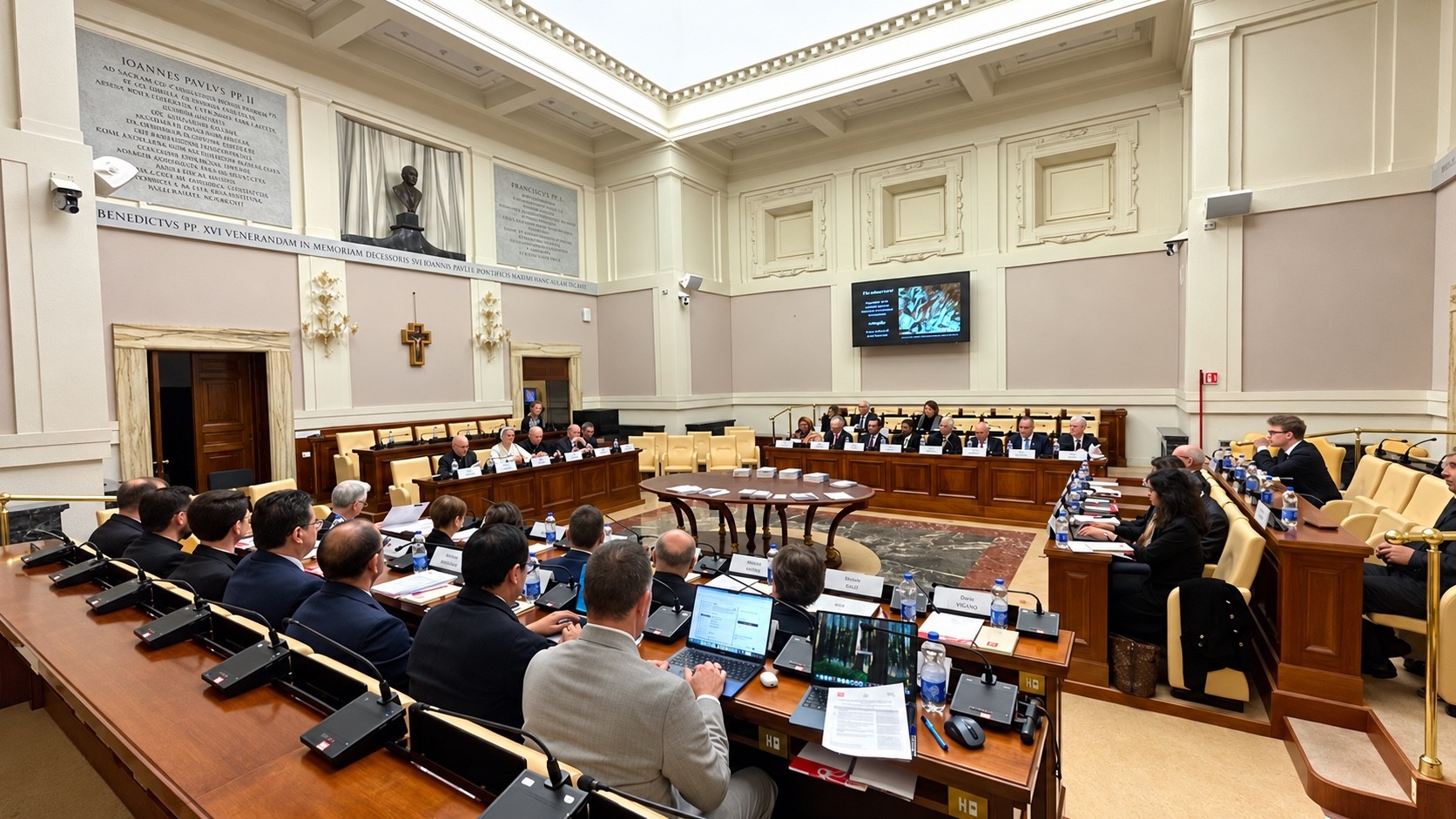
The development of artificial intelligence raises a crucial question: how can we ensure that increasingly powerful tools remain at the service of people? This question was the focus of the meeting held on 30 October at the Casina Pio IV, organised by the Pontifical Academy for Life and the Future of Life Institute.
The discussion brought together representatives of the Holy See and international experts. Cardinal Michael Czerny, President of the Vatican Commission on AI, stressed the need to translate ethical reflection into concrete policies and action. Archbishop Renzo Pegoraro emphasised the importance of ensuring that human responsibility remains clearly identifiable, while Sister Helen Alford underlined that social justice must guide technological design from the outset.
Stuart Russell and Max Tegmark raised concerns about losing control over increasingly capable systems. Father Paolo Benanti insisted on the need for binding rules and effective oversight, warning against appeals to ethics that have no practical consequences. Valérie Pisano highlighted the opportunities AI offers for research and climate action, while also calling for creativity, emotions and human relationships to be nurtured.
That same morning, Leo XIV received around twenty participants in the conference. The Pope observed that the future of AI depends on human choices: people must be able to steer its applications, modify them and, when necessary, reject them. The speed of development cannot become the sole criterion for assessment; reliability and the ability to manage the consequences must guide research.
Particular attention was paid to decisions involving life, freedom and the use of force. The Pope reiterated the need for informed and responsible human oversight, encouraging concrete steps towards a ban on lethal autonomous weapons.
Leo XIV also called for effective international institutions, shared criteria, independent oversight and mechanisms to establish accountability and provide remedies for those who suffer harm. The distribution of benefits is another central issue: healthcare, knowledge and opportunities generated by innovation must be equitably accessible, especially to the most vulnerable.
This approach finds a point of reference in the encyclical Magnifica humanitas, published on 15 May 2026. The document calls for technological progress to be assessed alongside the social and moral development that accompanies it. Greater technological capabilities alone do not guarantee an improvement in the human condition.
The encyclical also draws attention to the influence of large companies that control platforms, infrastructure, data and computing power. The concentration of these resources can make power less transparent and deepen dependencies, exclusion and inequality. Personal dignity, solidarity and the common good therefore become criteria for assessing digital transformations.
Education completes this picture. Schools are entrusted with the task of developing people’s ability to use new technologies critically and creatively. This also requires continuing professional development for teachers, so that they can help students understand these tools and their implications. Governing innovation therefore means investing in people’s capabilities as well as in the performance of machines.