
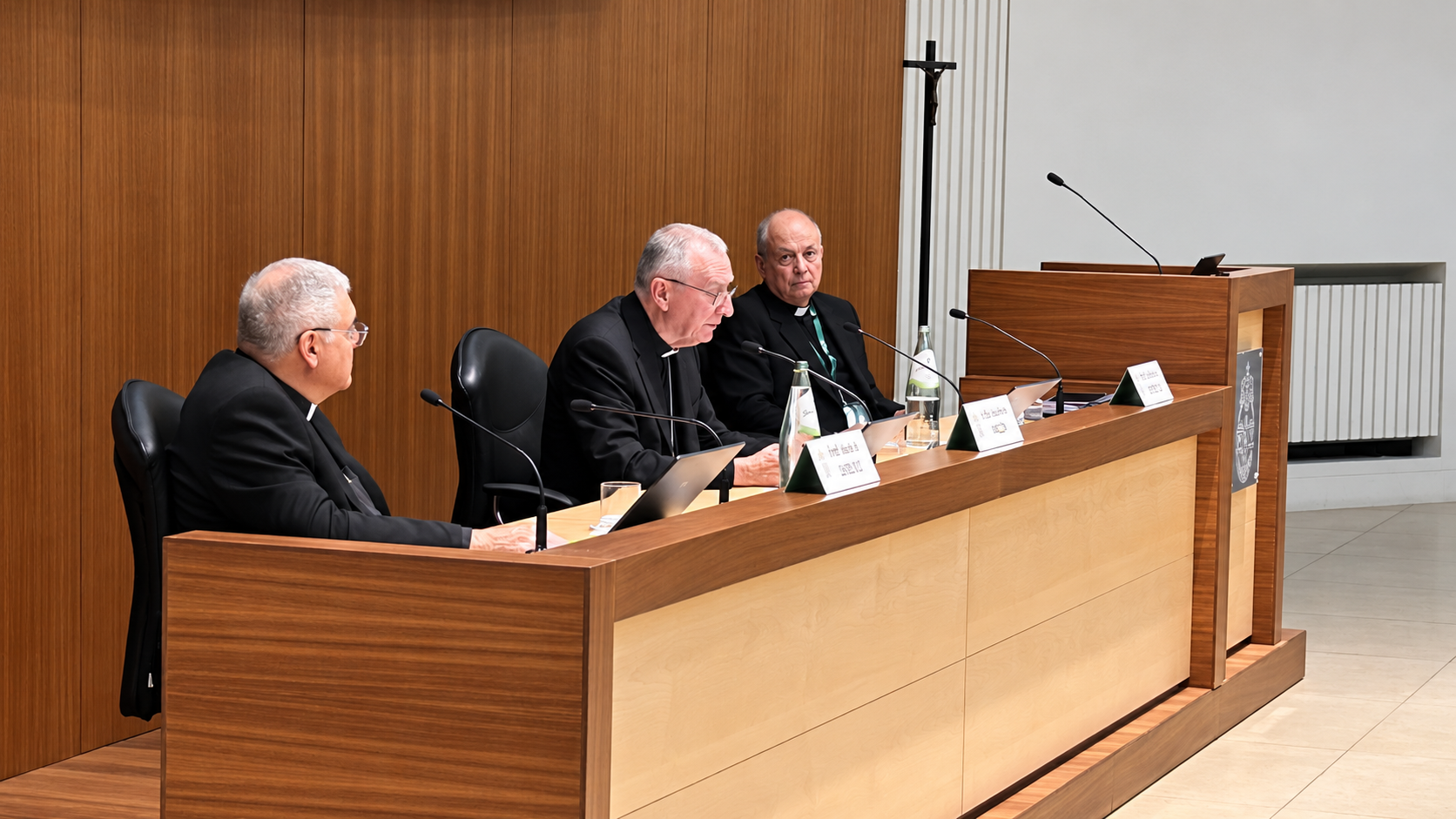
The law must govern artificial intelligence, protect human dignity and prevent technological progress from deepening inequalities. This was the message of Cardinal Pietro Parolin, Vatican Secretary of State, who on 20 October 2026 opened five days of meetings in Rome marking the 150th anniversary of the Faculty of Canon Law at the Pontifical Gregorian University.
In his inaugural address, the cardinal reflected on the fifth chapter of Leo XIV’s encyclical Magnifica humanitas, devoted to the relationship between the culture of power and the civilisation of love. His focus was the role of law in a context in which digital infrastructure and algorithms increasingly shape human relationships, institutions and the international balance of power.
For Parolin, legal education cannot be confined to knowledge of rules and procedures. It must prepare people capable of upholding the rule of law and guiding conduct towards justice. The law is called upon to curb abuse and oppression, especially when the exercise of force ends up excluding the most vulnerable and defenceless.
This responsibility takes on particular significance in the face of the digital revolution. Just as Rerum novarum addressed the question of human dignity in industrial society, Magnifica humanitas calls for the protection of the human person as artificial intelligence develops. Progress must not turn human beings into components of a system assessed solely on the basis of its performance.
Technological innovations, the Secretary of State observed, can foster participation and justice, but they can also extend control, inequality and exclusion. It is therefore necessary to assess whether the power of algorithms protects the most vulnerable, distributes opportunities fairly and remains directed towards the common good.
In this light, Parolin recalled the principles of the Church’s social teaching. The universal destination of goods requires access to technology and education; subsidiarity safeguards the ability of individuals and communities to make and revise their choices; solidarity demands recognition of the often invisible and exploited labour that sustains algorithmic systems. Social justice must also guide the design of technologies from the outset, as well as their assessment after deployment.
One of the main challenges concerns the concentration of technological power in the hands of private actors, often operating across national borders, whose resources and capabilities exceed those of many governments. This situation puts to the test the mechanisms through which states limit power and guarantee rights. Data collection and management can also become tools for predicting and steering human behaviour.
Faced with these changes, the cardinal set out three guiding principles for legal professionals and diplomats: disarm words, adopt the perspective of victims and cultivate a healthy realism. This means promoting language that encourages dialogue, taking into account the suffering of civilian populations and those forced to flee, and building paths to peace based on credible institutions, verifiable guarantees and patient negotiations.
The reflection also addressed the use of new technologies in warfare. Parolin recalled the encyclical’s call to move beyond just war theory, too often used to justify conflicts, while firmly upholding the right to legitimate self-defence understood in the strictest sense. The destructive power of modern weapons and the unpredictability of technological developments make their consequences increasingly difficult to contain.
The task of law therefore remains concrete: to safeguard people’s existence, freedom and relationships. According to Parolin, entrusting legislative or judicial decisions to predictive systems risks undermining the requirement to give reasons for legal acts and stripping the law of its essential grounding in justice. Hence his appeal for rules capable of governing artificial intelligence, tackling inequalities and making progress an opportunity shared by all.